

Socio-Ecological Transition

Much aware of the role it plays in supporting the Québécois cultural sector, the Machinerie has led in 2024 and 2025 a 3-phase project to improve the socio-ecological practices in the field. This project aimed to offer more resources to artists and cultural structures by adding to the Machinerie’s Toolbox, by offering a series of pedagogical activities and by developing a new module for its Learning Map covering these challenges.


The Three Phases of the Project

  • Phase 1 : Symposium on the Socio-Ecological Transition

One of the projet’s highlights was the symposium held from June 10 to 13, 2025 at Théâtre Aux Écuries. This event gathered members of the artistic community for workshops, round tables and discussions, fostering the sharing of knowledge and concrete tools for the socio-ecological transition.

  • Phase 2 : Improvements and Additions to the Toolbox

The Machinerie has enriched its Toolbox by adding new tools and updating those already offered by inserting references to tools covering the socio-ecological transition developed by peer organizations. The goal is to share practical resources adapted to the reality of artists and cultural structures. Among others, it covers theme such as digital sobriety, policies on sustainable development, ecodesign or socio-ecological budgeting. 

Following these changes, a series of Lunch-Chats was organized to present the improved tools and facilitate their integration by the cultural field.

  • Phase 3 : A 9th Module Added to the Online Learnign Map 

In addition to the 8 modules already available in its Learning Map accessible online for free, a ninth module especially developped on the topic of socio-ecological transition has been added to complete it. It offers informative videos, interviews with experts, practical exercises as well as references. It aims to facilitate the adoption of sustainable ecoresponsible practices for up and coming artists and new cultural structures.


The Machinerie firmly believes that the socio-ecological transition of the cultural sector works by collaborating and sharing knowledge. A free access to tools, events and Learning Map obline modules aims to insure a perennial and extended visibility to the newly offered contents.


Even though the project is now over, the Machinerie is continuously commited to the socio-ecological transition process by offering activities and other relevant content to accompany the cultural sector it this necessary evolution.


The socio-ecological transition project was made possible with the financial support of the City of Montréal through its Socio-ecolofical transition entrepreneurship chain consolidation program as well as from the Canada Council for the Arts.


Toolbox Index

Learning Map

The Learning map is a simple, easy-to-access self-learning tool for the arts and culture community. It consists of 8 modules covering the essentials of arts management. 

In each module, learners are invited to navigate between the information to discover :

  • Short presentation videos
  • Inspirational interviews with arts practitioners
  • Exercises for individuals and groups
  • References to tools, articles to read and organizations to discover 

The courses are designed to offer an interactive experience so that they can be consulted at one’s own pace, areas of interest and learning capacity. The modules aim to be an enriching and inclusive experience!

The 8 modules have been designed to personalize navigation within the course according to the user’s interests.

The modules : 

#1 : Overview of the arts ecosystem (French available/English coming soon)
#2 : Définir son identité artistique et ses communications (FR)
#3 : Gestion d’une production artistique (FR)

#4 : Rassembler une équipe de création et de production (FR)
#5 : How to write grant applications? (French available/English coming soon)
#6 : Diversifier ses sources de revenus (FR)
#7 : Tenir le cap sur sa gestion administrative (FR)
#8 : Déployer une pensée stratégique pour sa carrière et ses projets (FR)
#9 : La transition socio-écologique en culture (FR)
  • To access and explore the modules, log into our virtual space once you are part of our community. To join it and create your online account, follow these steps.
  • To search for specific tools and contents, consult our online directory.
  • Contact us for any other questions.

Ideation and content creation: Rachel Billet, Perrine Cadiou
Project coordinator and general graphic facilitator: José Lara Menéndez
Project assistant: Yvonne Patel
Content contributors: Marie Ayotte, Morgane de Bellefeuille, Thérèse Ghobriel, Devon Hardy, Ariel Lefebvre, Brice Noeser, Michaël Toppings, Ingrid Vallus
Écoscéno: Julie Fournier, Danny Gravel Marianne Lavoie, Anne-Catherine Lebeau, Morgane Parent (Module 9)
0/1 – Hub numérique: Filipa Didier (Module 9)
External feedback: Marie-Jeanne Beaulieu, Devon Hardy
Translation & revision: Bernadette Blain, Devon Hardy, Shérane Figaro, Ariel Lefebvre, Brice Noeser, Michaël Toppings, Yvonne Patel
Graphic facilitation (summary sheets): Visual Versa – Alina Gutierrez M.
Recording studio: Oboro
Recording et sound design: Juana Rubio (Module 9)
Production studio: Scratch Takes – John Castillo, Caylamina Roberts, Liz Bellotti, Alex Francoeur, Priam David
Graphic designer: Okhan Orhan
Voice actors: Maxime Beauregard-Martin (French), Laurence Clinton (English), Lucas DiTecco (English), Marianne Lamrche (French), Laurence Régnier (fFrench)
Interview guests: Lilie Bergeron, Julie-Marie Bourgeois, Alain Bourque, Kim-Sanh Châu, Olivier Ducas, Karla Étienne, Caroline Ferland, Catherine Gauthier, George Krump, Stéphanie Laurin, Sylvie Lavoie, Émilie Martel, Nick Maturo, Marlène Morin, Dorian Nuskind-Oder, Léa Philippe, Dominique Rheault, Angélique Willkie
Artwork in interviews: Dédale 22-01 de Jean-Sébastien Denis

The Machinerie wishes to thank the following organization for sharing some of their content:

Culture Montréal
Collectif des festivals
Terra Sapiens
TIESS – Territoires Innovantes en Économie Sociale et Solidaire
UQAM – Écoresponsable
UQAC

The Machinerie would like to thank its funders for their trust in this initiative and for their financial support throughout the creation of the Learning map. The Learning map was funded with the support of the Government of Canada, the Canada Council for the Arts and the City of Montréal.

The Essentials

The Essentials are 60-minute online lunchtime training sessions given by a guest on a specific arts management topic. These one-time events are part of a larger series of events that respond to a broad theme.

The Essentials were developed to provide an opportunity for artists to do a quick learning event that is easier to fit into their schedule than a longer educational activity. In a presentation format, our guest will share knowledge and experiences related to the topic. At the end of the session, participants will be able to ask questions in the chat room but there will be no discussion period.

In order to make this activity accessible to as many people as possible, we have opted for a scale of rates to allow each person to contribute according to their means: $10 (accessible rate), $15 (regular rate), $20 (generous rate).

Coffe-Chats & Lunch-Chats

The Coffee-Chats or Lunch-Chats are morning or lunchtime professional gatherings in which we introduce you to a personality who inspires us and who holds a remarkable uniqueness. These occasional activities are part of a larger series of activities that respond to a major unifying theme. The Coffee-Chats / Lunch-Chats were set up with the objective of enhancing some of our professional relationships, breaking isolation, arousing inspiration and curiosity, and even answering some organizational questions that might be on the minds of artists and cultural workers.

In the format of an interview, our guest discusses with a member of the Machinerie team a subject of concern to us in order to highlight their innovative approaches. Also, with the idea of initiating discussions on management practices, a period of exchange with the public is always planned, in order to respond to certain real needs and issues experienced by members of the cultural community.

À la Carte Services

À la Carte Services are customized, ad hoc support services provided by the Machinerie team to meet the immediate organizational needs of artists and arts companies. They can take various forms.
The Machinerie’s team of seasoned managers have complementary areas of expertise. They are now making their skills available to help build management capacity in the arts community. The Machinerie consultant will work in a spirit of collaboration and experience-sharing to help meet organizational needs.

Examples of À la Carte Services :

  • Strategic consulting and planning
  • Review of grant applications (in English and/or French)
  • Idea development for a communications campaign
  • Project management (web redesign, daily work organization, etc.)


To apply for this service: contact  info@machineriedesarts.ca.

Note that the availability of À la Carte Services is subject to the skills and schedules of the Machinerie team.

Toolbox

The Machinerie’s Toolbox contains over 300 practical and strategic tools designed to improve management of artistic projects and cultural organizations. It provides professional frameworks for planning, organization and simplified management in the area of culture. The purpose of the tools is to improve and facilitate quality of work through templates, guides, outlines and methods for immediate application to specific work situations.

A vast array of guides and theoretical solutions is available. The Machinerie’s project was to develop practical tools built by the people who use them. We therefore worked with experienced managers to compile and compare current work methods.

The results are tools that are versatile, collaborative and informative, but especially simple to use. The Machinerie is aware that there are many different work solutions and these tools are intended to be among the many legitimate options out there.

To access the tools

The Toolbox is a unifying project that mobilized 16 leading partners in the culture sector, over 20 cultural creators/tool developers and 5 financial partners. The free distribution of the tools is designed to democratize knowledge and foster professional development.

Financial partners: Conseil des arts du Canada, Conseil des arts de Montréal, Caisse de la culture, Gouvernement du Québec, English-Language Arts Network (ELAN).

Creative content partners: Agence Mickaël Spinnhirny, Culture Montréal, Culture pour tous, École national de théâtre (ENT), English-Language Arts Network (ELAN), Québec numérique, LA SERRE – arts vivants, La Vitrine culturelle de Montréal and Youth Employment Services (YES).

Creative team: Rachel Billet, Morgane De Bellefeuille, Mark Lawes, Ariel Lefebvre, Jod Léveillé-Bernard, Katherine Lynch, Roxana Pasca, François Richer, Danielle Thibault and Ingrid Vallus.

Toolmakers: Benjamin J. Allard, Pierre-Marie Audard, Amélie Aumont, Laureen Bardou, Lesley Bramhill, Adrien Bussy, Hélène Couture, Anne-Flore de Rochambeau, Catherine Desjardins-Jolin, Karla Étienne, Caroline Ferland, Josée Guérette, George Krump, Patrick Lloyd Brennan, Amy Macdonald, Joana Neto Costa, Sarah Pinelle, Jean-Pierre Primiani, Lydie Revez, Hanneke Ronken, Jovanny Savoie, Olivier Simard-Hanley and Sébastien Turcotte.

Associates:  Analogos | John Detre, Bernadette Blain, Gonzalo Coloma-Rospigliosi, Hanna Sybille Müller and Sophie Préfontaine.

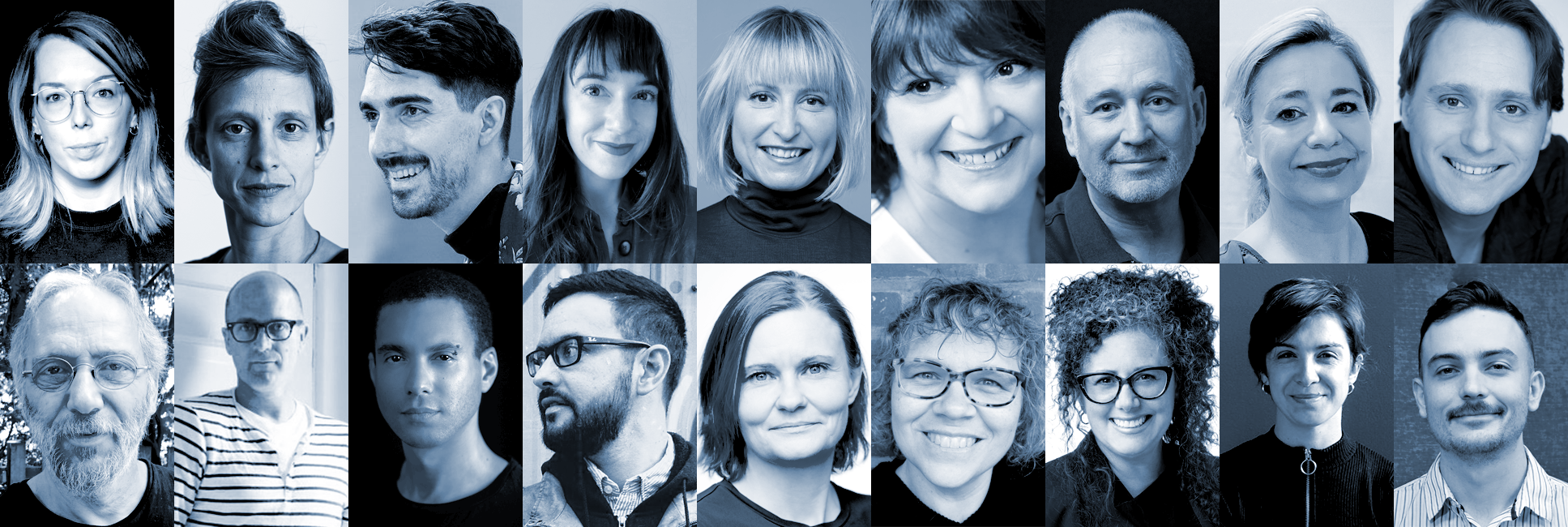
From the left: Josée Guérette, Hanna Sybille Müller, Benjamin J. Allard, Amy Macdonald, Bernadette Blain, Danielle Thibault, George Krump, Hanneke Ronken, Jod Leveille, John Detre, Mark Lawes, Patrick Lloyd Brennan, Adrien Bussy, Lydie Revez, Hélène Couture, Sophie Préfontaine, Joana Neto, Olivier Simard-Hanley

360 Clinics

The 360 Clinics are designed to equip the next generation of artists who want to develop independence and acquire new management skills. The clinics take the form of six micro-training sessions that cover a number of topics in administration, strategy and communications.

During the meetings, we aim for a cohort effect. Participants are asked to share their issues and experiences in relation to the theme of the workshop in question. A climate of learning is fostered through this exchange as well as via contributions from the Machinerie’s team as well as guest speakers.


There is currently no registration period for the 360 Clinics.


Cohort 22-23 | in partnership with Montréal, arts interculturels (MAI)
Hanna Zoubeida Krabchi, Sonia S Reboul, Akim Ade Larcher, Emmanuel Zuniga Salas, Shanna Aristil, Bea Chintoh, Paola Andrea Sterling, Viktor Zeta, Elahe Moonesi, Dulce Pinzon, Luis Antonio Rocha, Maryam Eizadifard, Juan Carlos Prada, Martin Dang and Steffie Boucher.


Cohort 21-22 | in partnership with Théâtre Aux Écuries

Mélodie Bujold-Henri, Olivier Hardy, Juliette Ouimet, Maude Choquet-Blanchette and Juliette Pottier Plaziat (Collectif NU.E.S), Hilaire and Sofia (Les Créations Unuknu), Chann Delisle (Moutarde Forte), Louis-Philippe Savard (Théâtre le Mimésis), Emilie Demers and Romain Gailhaguet (Collectif Flow), Karine St-Arnaud (Théâtre sous la Main), Ines Adan and Paola Huitron (NoMásClavos), Léa Plissoneau and Anaëlle Lacoste (Elles fallait), Maxime Mompérousse and Gabrielle Bertrand-Lehouillier.

Cohort 21-22 | in partnership with Montréal, arts interculturels (MAI)

Nikita Peruzzini, Charles Gao, Chantal Partamian, Carolina Chmielewski Tanaka, Ellie Chartier, Nicole Leroux, Germain Ducros, Camille St-Jacques Couture, Lidia Barreiros, Margaux ORST, Myriam Le Ber Assiani, Sarah Toung ondo, Fiorella Giuliana Litán Pineda, Hoor Malas, Alida Esmail and Favielle Petit Clair.

Cohort 21-22 | in partnership with the Conseil culturel et artistique francophone de la Colombie – Brittanique (CCAFCB)

Kris Fleerackers, Thérèse Champagne, Ingrid Brousillon, Joylyn Secunda, Anaïs Pellin, Isabelle Rousseau and Audrey Gaussiran.


Cohort 20-21 | in partnership with Montréal, arts interculturels (MAI)
Soroush Aram, Baharan Baniahmadi, Davide Chiazzese, Marthe Halvorsen, Moïa Jobin-Paré, Hea R. Kim, Lynn Kodeih, Paige Krämer Rochefort, Nasim Lootij, Alyag Malkhassian, Diyar Mayil, Renata Paciullo Ribeiro, Lavinia Picu, Patil Tchilinguirian, Kathy Alexandra Villegas and Elsy Zavarce.

Cohort 20-21 | in partnership with Théâtre Aux Écuries
Sofia Blondin, Laurence A. Clavet (Théâtre des Trompes), Sarianne Cormier, Laurence Emery, Marie-Ève Groulx (Collectif Tôle), Marina Harvey (Collectif Tôle), Antonia Leney-Granger (Théâtre du Renard), Gabriel Morin (Le Complexe), Véronique Pascal (Les compagnons baroques), Anaïs Pellin (Kleine Compagnie), Isabel Rancier (Théâtre du Fret), Karine Sauvé (Mammifères), David Strasbourg (Le Complexe) and Marc-André Trépanier.


Cohort 19-20
Marie-Jeanne Beaulieu, Jean-François Boisvenue (La nuit / Le bruit), Anneke Brier, Késia Demers (Productions Erapop), Nicolas Guillemette, Gabriel L’Archevêque (Productions Erapop), Léo Loisel (Castel Blast), Antoine Pelletier (Productions Erapop), Guillaume Rémus (Castel Blast), Claire Renaud (La nuit / Le bruit), Stefania Skoryna (Nous Sommes L’Été), Olivia Sofia (Castel Blast).

Orientation Session

This brief meeting with the Machinerie’s team provides an opportunity to analyze the organizational requirements associated with the management of an artistic project, to reflect on the organization’s stages of deployment or to clarify its programming calendar.

Using tables, schedules and checklists, the Machinerie helps artists identify their priorities, set goals and discover potential solutions to facilitate the management of their operations. Orientation sessions are also an opportunity for the Machinerie’s team to pinpoint which of its services and/or tools may be useful to the artist for a specific project or request.

To access this service, please make an appointment by selecting a time slot and specifying the reason why you wish to meet with us. Please note that due to a high volume of requests, our availability may be limited.

Expert Workshops

Our Expert Workshops provide a forum for artists and cultural workers to share experiences. Each workshop has a theme selected in line with concerns identified by the Machinerie’s members. In a small-scale setting, facilitators lead an exchange based on the participants’ realities and issues. At the end, participants are able to enrich their professional practice and identify potential solutions for tackling the issues addressed.